
- Mon - Sat 8:00 - 6:30, Sunday - CLOSED
- support@soundproofhub.com
When Acoustic Baffles Suspended Ceiling

23
October
When Acoustic Baffles Suspended Ceiling
Open-plan offices, busy restaurants, high-ceiling lobbies, and educational halls all share a common issue: unwanted noise. When sound waves bounce off hard surfaces like concrete, glass, and drywall, echo builds up quickly. This excessive reverberation creates a noisy environment where conversations become difficult to understand and focus plummets.
Addressing noise issues overhead is often the most practical solution. Installing a suspended acoustic baffle ceiling allows you to absorb echo without taking up valuable wall or floor space.
In this guide, we will explore what acoustic baffles are, how acoustic baffles work, and when acoustic baffles suspended ceiling setups are the best choice for your building design.
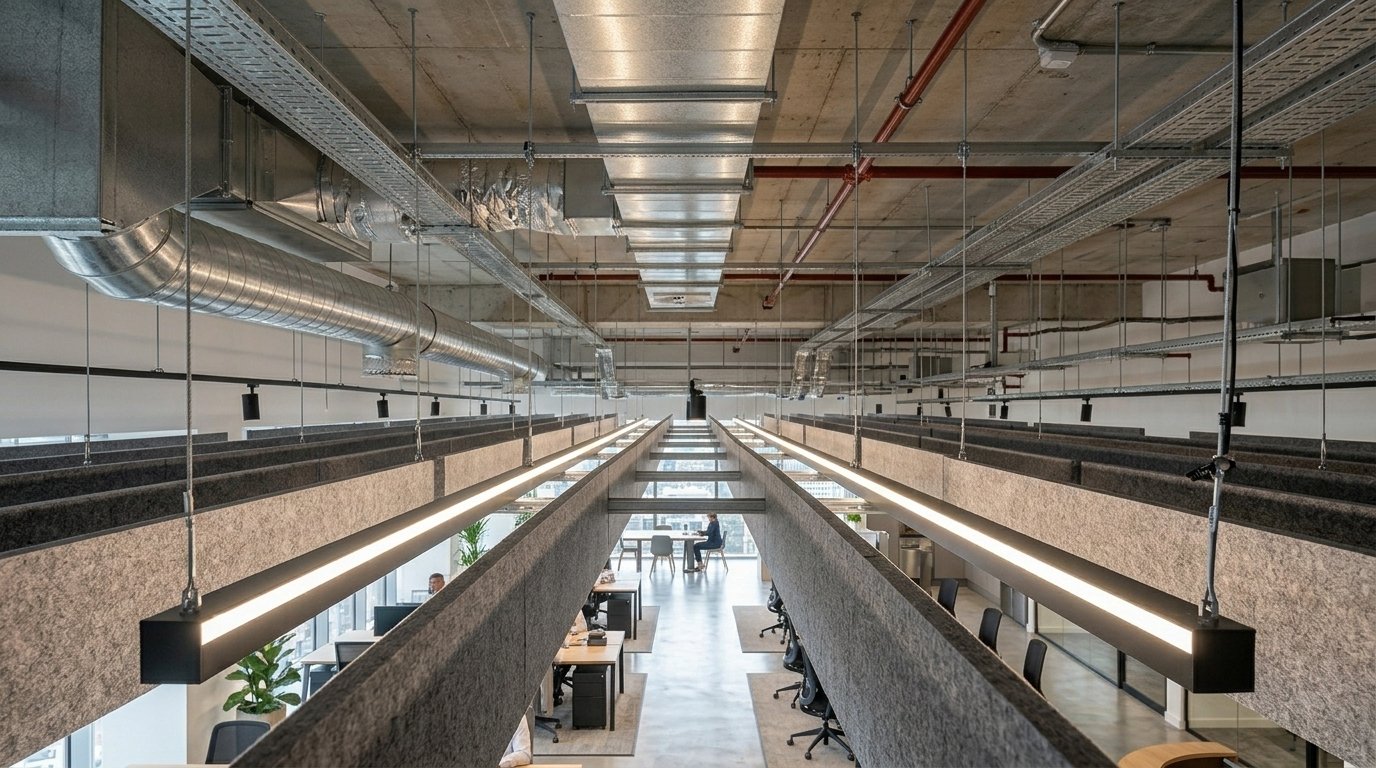
What Are Acoustic Baffles and How Do They Work?
Acoustic Baffle Meaning and Core Purpose
To understand their value, it helps to start with the fundamental acoustic baffle meaning. An acoustic baffle is a sound-absorbing panel suspended vertically from an overhead structure or ceiling grid.
Unlike flat ceiling tiles that lie parallel to the surface, vertical acoustic dampening baffles hang downwards, exposing both sides of the panel to room sound waves.
+-------------------------------------------------+
|               STRUCTURAL CEILING                |
+-------------------------------------------------+
       |                                   |
   [Cable/Wire]                        [Cable/Wire]
       |                                   |
+--------------+                   +--------------+
|   ACOUSTIC   |                   |   ACOUSTIC   |
|   BAFFLE     | <--- Sound Waves  |   BAFFLE     |
| (Front & Back|     Absorbed From | (Front & Back|
| Absorption)  |      Both Sides   | Absorption)  |
+--------------+                   +--------------+
What Do Acoustic Baffles Do?
So, what do acoustic baffles do inside a room? Their primary function is noise attenuation—reducing sound reflection and controlling reverberation time.
-
Sound Absorption: Incoming sound energy enters the porous core material and turns into low-level heat rather than echoing back into the space.
-
Dual-Surface Exposure: Because both sides are open to the air, ceiling hung acoustic baffles offer double the sound-absorbing surface area compared to traditional flat wall panels.
-
Spatial Efficiency: They capture ambient sound elevated above the work plane before it travels across large open rooms.
What Are Acoustic Baffles Made Of?
Modern manufacturers craft these absorbers out of several high-performance materials depending on design, budget, and durability needs:
-
PET Felt: Made from recycled plastic bottles, pet felt acoustic baffles are eco-friendly, lightweight, and durable.
-
Acoustic Foam: Acoustic foam baffles offer lightweight sound absorption suitable for budget-conscious interior setups.
-
Wrapped Fiberglass or Mineral Wool: High-density cores deliver class A acoustic baffles performance for maximum sound absorption across broad frequency ranges.
-
Wood and Timber Finishes: Wood look acoustic baffles or acoustic timber baffles provide warmth and natural aesthetics for executive suites and high-end interiors.
-
Metal: Metal acoustic baffles feature micro-perforated aluminum or steel shells stuffed with sound insulation for industrial spaces.
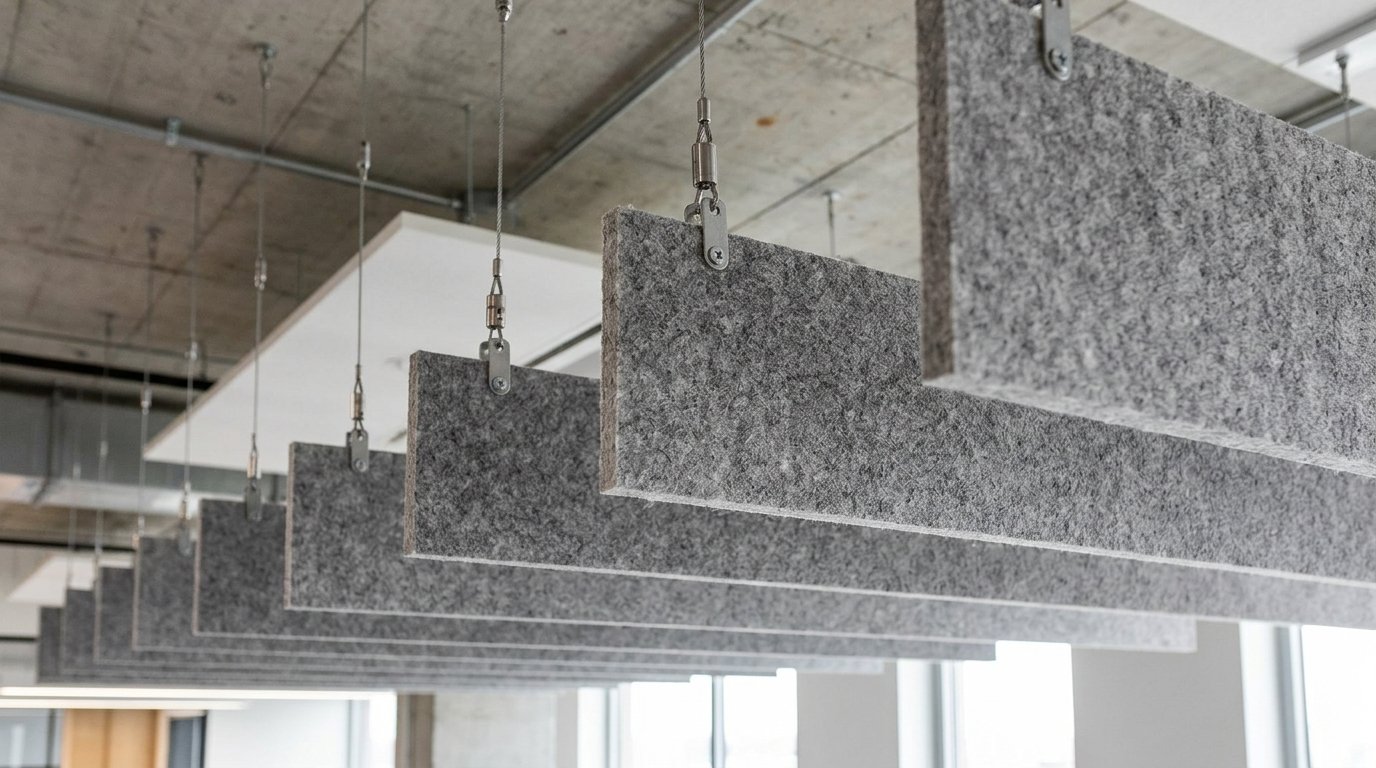
Acoustic Baffles vs Panels and Clouds: Choosing the Right Layout
When planning an overhead acoustic treatment, designers often debate between panels, clouds, and vertical baffles. Understanding the differences ensures you select the right layout for your room geometry.
| Feature | Acoustic Baffles | Acoustic Clouds | Wall Acoustic Panels |
| Orientation | Vertical suspension | Horizontal suspension | Surface-mounted flat |
| Best For | High ceilings, masking utilities | Targeted seating areas | Standard ceiling heights |
| Airflow Impact | Minimal interference | Can trap heat/airflow | No impact on ceiling systems |
| Visual Effect | Dynamic linear lines | Floating geometric islands | Subtle wall accents |
Acoustic Baffles or Clouds?
Choosing between acoustic ceiling baffles or clouds depends on ceiling height and mechanical layout. Acoustic baffles clouds combinations are also popular, but vertical hanging acoustic baffles ceiling designs excel when you need to maintain open vertical airflow and access to overhead MEP (mechanical, electrical, plumbing) infrastructure.
If a horizontal ceiling treatment is more suitable for your space, our guide to acoustic ceiling rafts explains their applications, designs, and benefits for controlling echo in large rooms.
When to Install an Acoustic Baffles Suspended Ceiling
Knowing when acoustic baffles suspended ceiling layouts should be specified can save project time and acoustic remediation costs. Here are the primary scenarios where vertical hanging baffles perform best.
          [ SUSPENDED CEILING BAFFLE ADVANTAGES ]
                             │
     ┌───────────────────────┼───────────────────────┐
     ▼                       ▼                       ▼
High Ceilings &         Exposed Ductwork        Lighting & HVAC
 Unbroken Spaces          & Modern Concrete        Air Flow Needs
1. High Ceilings and Open-Plan Spaces
In large architectural spaces with lofty deck heights—such as auditoriums, open offices, and athletic gyms—sound travels long distances and reflects repeatedly. Standard wall panels are often too far from the sound source to be effective.
Installing acoustic baffles for high ceilings intercepts sound waves elevated overhead, trapping reverberation near the source.
2. Exposed Concrete and Modern Industrial Designs
Modern architecture heavily features exposed concrete, open ductwork, and broad glass facades. While aesthetically striking, these hard materials reflect sound efficiently.
An acoustic baffles suspended array adds soft, porous surfaces overhead without hiding structural elements or lowering light levels.
3. Integrated Lighting and Ventilation Requirements
Traditional flat drop ceilings block vertical airflow and require extensive recessed light fittings. In contrast, acoustic baffles with lighting feature integrated LED strips running along the bottom edges of the baffles.
This provides task lighting and acoustic treatment in one seamless fixture. Additionally, vertical acoustic baffle vent gaps allow HVAC air to circulate freely.
For more ideas on combining sound absorption with functional lighting, explore our guide to acoustic lighting fixtures and compare options for modern offices and commercial interiors.
Key Design Considerations and Installation Best Practices
Acoustic Baffles Dimensions and Spacing
Achieving optimal acoustic control requires balancing panel dimensions and placement spacing:
-
Acoustic Baffle Height: Standard heights range from 6 inches to 24 inches (150 mm to 600 mm). Taller baffles increase low-frequency absorption.
-
Acoustic Baffles Spacing: Spacing between parallel rows typically ranges from 12 to 24 inches. Setting rows too close together blocks sound from reaching the back surfaces, while spacing them too far apart allows sound to pass untreated.
      Optimal Spacing (12" - 24" Gap)
         <-------->
   +---+          +---+          +---+
   |   |          |   |          |   |
   |   |          |   |          |   |  <- Height (6" - 24")
   |   |          |   |          |   |
   +---+          +---+          +---+
Installation Methods
Proper acoustic baffles installation ensures structural safety and clean architectural lines. Baffles can be hung using adjustable aircraft cables, direct-to-grid hardware, or threaded suspension rods attached to structural steel.
Common Mistakes to Avoid
-
Overcrowding Baffles: Hanging panels too close together reduces the effective surface area exposed to sound waves.
-
Ignoring Fire Ratings: Always confirm that specified materials meet local building safety standard flame-spread requirements.
-
Neglecting Utility Clearance: Plan around sprinkler heads, smoke detectors, and HVAC diffusers during layout design.
Regional Availability and Leading Brands
Top commercial suppliers offer specialized baffle designs tailored to varied architectural needs:
-
Global Brands: Leading manufacturers such as Rockfon contour acoustic baffles, Ecophon, Autex, USG, Zintra, and Knauf supply tested systems across North America, Europe, Asia, and Australasia.
-
Regional Markets: Specify certified local distributors whether sourcing acoustic baffles Canada, acoustic baffles UK, USA, or regional suppliers in Australia, India, and the Philippines.
Conclusion
An acoustic baffles suspended ceiling system offers an ideal balance of acoustic performance, modern aesthetic appeal, and structural flexibility. By intercepting sound waves vertically overhead, baffles eliminate echo without sacrificing natural light, ventilation, or open architectural design.
Are you planning an acoustic upgrade for an open office, restaurant, or commercial building? Evaluate your ceiling height, light layout, and target noise reduction goals to choose the optimal baffle design for your space.
Frequently Asked Questions
Do Acoustic Baffles Really Work?
Yes, do acoustic ceiling baffles work effectively? Absolutely. By exposing sound absorption material on both sides, hanging vertical baffles efficiently reduce reverberation time and lower ambient noise levels in high-volume spaces.
Can Acoustic Baffles be Repaired or Cleaned?
PET felt and metal baffles can be vacuumed or spot-cleaned with mild soapy water. Damaged fabric or foam baffles can often be recovered or re-hung individually without replacing the entire ceiling system.
Are Acoustic Baffles Expensive?
While acoustic baffles cost varies by material (PET felt vs. custom timber), vertical baffles are often more cost-effective per square foot of sound absorption than full wall-to-wall acoustic tile ceilings.


Muhammad Zeeshan
Muhammad Zeeshan is an SEO expert and content writer, specializing in link building (SaaS, Tech, Business, and Home Improvements). I am very passionate about search engine optimization, backlink building, and guest blogging. I can help you in attracting a new audience and in achieving a higher rating.